Green Practice News March 2026

Green Practice News – March 2026


In This Issue:

  • “I Chose a Climate Resilient Practice”   
  • The Next Generation of Clinicians Is Choosing Purpose — and Healthcare Organizations Are Being Evaluated Accordingly
  • Helping Children Save Energy-
    Building Health, Confidence, and Lifelong Habits


About this issue:

Is your clinic or practice ready for the next generation of dynamic, community-focused doctors and nurses? My Green Doctor meets with hundreds of early career clinicians each year and we see an unmistakable trend. Our first two articles this month focus on the keen expectations by Under Forty professionals that their workplaces be committed to  environmental sustainability.

Our third article focuses on energy literacy and children’s health, reframing household energy-saving behaviors as a simple yet powerful health intervention that builds confidence, reduces anxiety, and supports lifelong healthy habits.


My Green Doctor’s Executive Director Dr. Todd Sack is the lead speaker for an upcoming free one-hour webinar on the benefits of environmental sustainability and how to get started in your medical or dental practice:

“Adding Environmental Sustainability and Climate Resilience to Your Clinical Practice”

Date & Time: March 19, 2026 19:00 Eastern Time (US and Canada)

Sponsored by:  Junior Doctors Network of the World Medical Association.
Register at: https://us06web.zoom.us/meeting/register/rCEC-yMiQqiD2S8-ft4Gow
Or join with Zoom Meeting ID 833 5656 0658 Passcode 639879


I Chose a Climate Resilient Practice for My Career

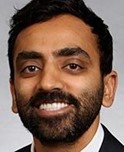
by Ashray Maniar MD
Medical Oncologist

I have had many moments wracked with climate despair. Each annual report from the Intergovernmental Panel on Climate Change has felt like gasoline being poured on an actual wildfire, and all I had to fight back with was water balloons. I knew when I began looking for a place to practice the career that I love—hematology and oncology – that the values and culture of where I choose to work would be as important as the salary and the lifestyle.

It took the wisdom of Jon Stewart, spoken in response to a different tragedy, to shift my perspective from despair to possibility: “I want to tell you why I grieve, but I won’t despair.” He went on to highlight the power of humanity during recovery and our shared, enduring spirit—the ability to find beauty even amidst a sea of despondence. As physicians, we understand this distinction well. We must grieve losses honestly without slipping into despair, so that we can continue to support our patients, colleagues, and families. It took me a while, but I eventually learned how to channel that same resilience into doing my part to mitigate climate change.

Most clinicians acknowledge climate change and make some efforts to reduce their personal carbon footprints. What often comes as a surprise, however, is that our healthcare sector is responsible for nearly 5% of global greenhouse gas emissions. To be fair, medicine is inherently energy intensive—saving lives tends to require electricity, supplies, and overly packaged pharmaceuticals. But that familiar mentality of “you gotta break a few eggs to make an omelet” has been stretched too far, particularly in the United States.

From 2010 to 2018, U.S. healthcare greenhouse gas emissions rose by 6%, reaching 1,692 kilograms of carbon dioxide equivalents per capita— by far the highest rate for healthcare in any country. Even as we seek to preserve life, the air pollution created by our industry is taking lives due to heart attacks, asthma, COPD, and cancers. In 2018 alone, emissions from greenhouse gases and toxic air pollutants were associated with the loss of 388,000 disability-adjusted life-years.

What makes this especially unsettling is that these rising emissions are not matched by superior health outcomes compared to peer nations. In other words, we are ruining the planet – breaking lots of eggs—without commensurate better health for our people. This realization pushed me to think differently about where I chose to practice medicine.

I became committed to practicing medicine in ways that reduce healthcare-related emissions while protecting both current and future communities. Individual actions, while important, are not enough to meaningfully address climate change. When I finished my medical training and began searching for my first practice, I prioritized finding a climate-conscious institution—one where my wilted water balloons could be replaced with effective action on climate change.

My search led me to Northwest Permanente at Kaiser in Portland, Oregon. Northwest Permanente is the first physician-led group to earn B Corp Certification, a rigorous international standard that reflects Northwest Permanente’s  commitment to environmental sustainability, accountability, and transparency. While the designation itself is impressive, what matters most are the day-to-day practices that I have observed: not pre-opening surgical packs, reducing climate-warming inhaled anesthetics, and prioritizing more sustainable products. These changes may sound small, but collectively they represent a meaningful shift in how healthcare can be delivered more responsibly. Since joining, I’ve been welcomed into climate-focused initiatives, particularly within my department of hematology-oncology. I feel that here my  climate values are supported and empowered.

Through this work, I’ve witnessed the resilience of people and the power of collective action. There are still moments when I grieve the damage we’ve caused—both as a profession and as a species—but I no longer despair. My water balloon may still be imperfect, but now it’s backed by a team, a system, and the belief that medicine can be part of the solution rather than part of the problem.

Dr. Maniar is a medical oncologist at Kaiser Permanente in Portland, OR. He focuses on treating patients with head and neck and thoracic malignancies. He grew up in Glen Dale, WV. He is an avid basketball fan (go Blazers!), nature enthusiast and is trying to learn to surf (but spends most of the time belly flopping into the ocean). 


The Next Generation of Clinicians Is Choosing Purpose — and Healthcare Organizations Are Being Evaluated Accordingly

A growing body of research makes one thing clear: climate change and environmental sustainability are no longer peripheral issues in healthcare. They are increasingly shaping professional identity, workplace expectations, and career decisions — particularly among early career clinicians.

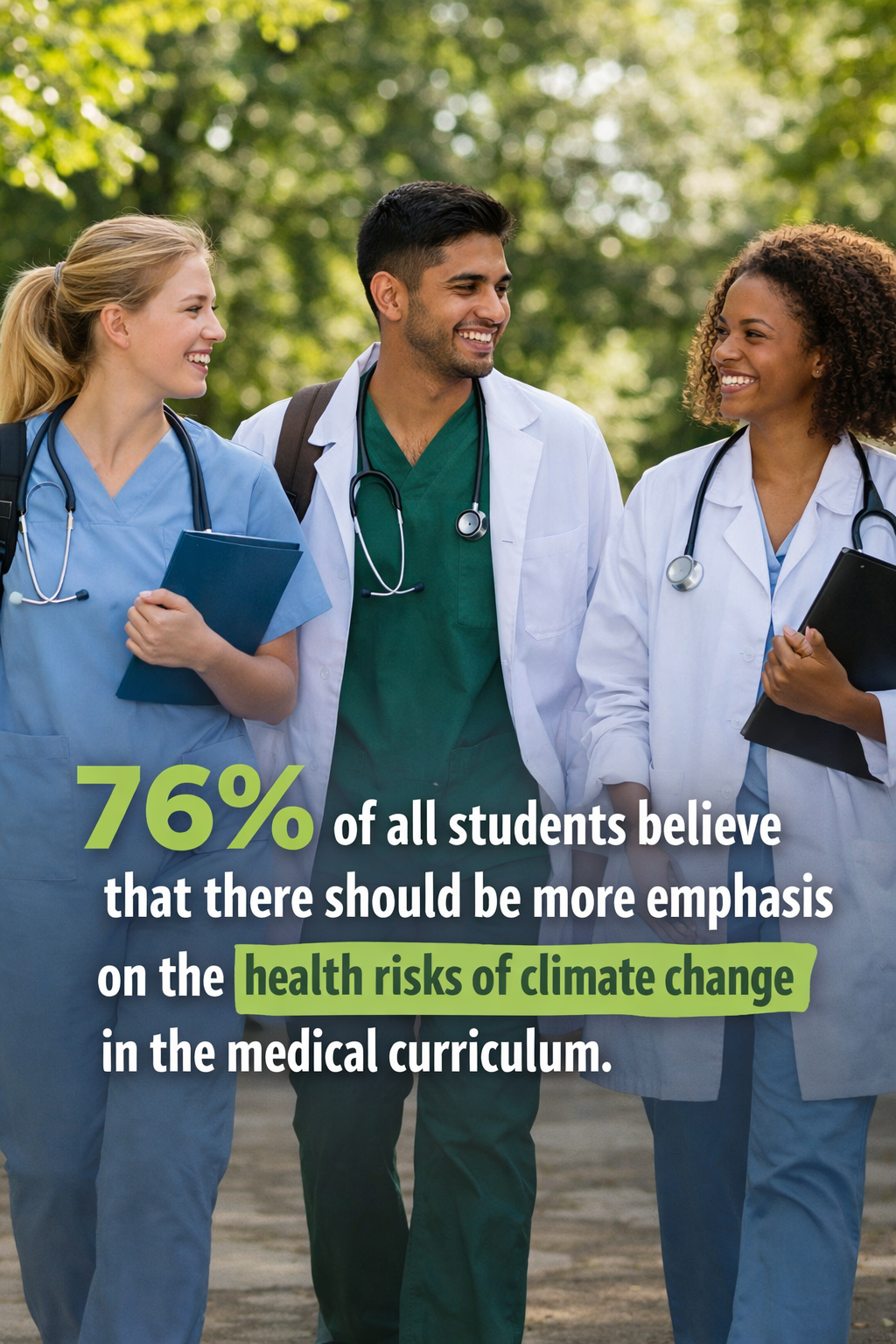
A recent national survey of Dutch medical students and recent graduates found that 72% reported there were no educational sessions in their curriculum addressing the health risks of climate change, while 76% believed there should be more emphasis on the health impacts of climate change in medical education. This gap between expectation and formal training is striking.

These findings suggest two important realities. First, future clinicians understand that climate change is directly connected to patient health — through heat-related illness, respiratory disease, infectious disease spread, food insecurity, and mental health stressors. Second, they perceive that their education systems are not yet fully preparing them to address these realities in practice.  The implications extend beyond medical schools. As these students move into residency and early-career practice, their expectations do not disappear. Instead, they carry them into career choices and workplace evaluations.

Increasingly, early-career clinicians are assessing potential employers not only on compensation and scheduling, but on whether an organization’s stated values are reflected in operational behavior. Sustainability is becoming one of those markers.

Medical oncologist Dr. Ashray Maniar practices at Northwest Permanente at Kaiser in Portland, Oregon. He speaks publicly about choosing to work within a system that takes climate responsibility seriously. His decision was not based on perfection. Rather, it was grounded in whether the organization he would work with acknowledges healthcare’s environmental footprint and demonstrates structured support for meaningful improvement.

That distinction is important. Young clinicians are not expecting flawless systems. They are looking for credibility, accountability, and visible progress.

This trend is reinforced by data from the United States. In a recent Commonwealth Fund report, a large proportion of surveyed U.S. healthcare workers statted that they want their employers to address climate change and reduce environmental impact. Many indicated that organizational commitment to sustainability influences morale and long-term engagement.

Healthcare systems today are navigating one of the most competitive labor markets in recent history. Recruitment and retention remain top operational concerns worldwide. Within this environment, sustainability is emerging not as a marketing message, but as a component of workforce strategy. Organizations that integrate sustainability into core operations — rather than treating it as an add-on initiative — position themselves more competitively in attracting values-driven clinicians.

Many health systems are taking solid sustainability steps in their hospital buildings but most are ignoring their hundreds of owned clinics and affiliated practices. For clinics and health systems, the challenge lies in translating intention into structured action. Sustainability must be operationalized in ways that align with clinical priorities, financial realities, and patient care standards. It must be visible in leadership decisions, procurement practices, energy use, waste reduction strategies, and staff engagement processes.

This is where structured coaching and consulting can play a meaningful role. My Green Doctor’s practice management program helps clinics embed evidence-based sustainability improvements directly into everyday clinical operations. By guiding leadership teams and staff through achievable, measurable steps, sustainability becomes part of organizational culture rather than an additional burden placed on already stretched clinicians.

When environmental responsibility is integrated thoughtfully — with practical tools, clear frameworks, and leadership support — it strengthens both operational performance and workplace trust.

This signals something powerful to young healthcare professionals, that their concerns about climate and patient health are recognized and supported. For organizations, it provides a pathway to differentiate themselves in a competitive hiring landscape while improving efficiency and long-term resilience.

Healthcare has always evolved in response to emerging public health challenges. Climate change represents one of the defining health challenges of this generation. As medical education, workforce expectations, and organizational leadership continue to adapt, sustainability is becoming part of what it means to practice responsible medicine.

References
Dutch medical student sustainability report:
https://degeneeskundestudent.nl/wp-content/uploads/2023/09/Rapport-Duurzaamheid-Engels.pdf
Commonwealth Fund Issue Brief (January 2024):
https://www.commonwealthfund.org/publications/issue-briefs/2024/jan/us-health-care-workers-want-employers-address-climate-change
HealthManagement.org article on recruiting for sustainability:
https://healthmanagement.org/uploads/article_attachment/hm1-25-recruiting-for-sustainability-print.pdf


Helping Children Save Energy-
Building Health, Confidence, and Lifelong Habits

Children today are growing up with an awareness that previous generations never faced: climate change will affect their health, communities, and future opportunities. For many families, this awareness brings concern—and in some cases, anxiety. Research increasingly shows that engaging children in practical solutions, rather than shielding them from the issue, is one of the most effective ways to support their mental well-being.

A 2023 report from the American Psychological Association found that climate-related worry is rising among children and adolescents, and that action-oriented coping strategies are associated with lower distress. Helping children save energy is one such strategy. It is simple, concrete, and empowering.

As Dr. Todd Sack wrote in My Green Doctor’s original article on the topic, “It’s easy and smart to help your children to save energy.” These everyday actions do more than reduce household utility bills. They help children develop a sense of agency and reinforce the connection between daily choices, health, and the environment.

Energy Use Is a Health Issue

From a clinical perspective, energy use is not an abstract environmental concern. It directly affects air quality, heat exposure, and respiratory health—issues that pediatricians, family physicians, and internists address daily. Air pollution remains one of the leading environmental threats to children’s health, contributing to asthma, impaired lung development, and increased emergency department visits.

Teaching children about energy choices—such as turning off unused electronics, reducing “phantom load,” taking shorter showers, or choosing fans before air conditioning—connects environmental responsibility to tangible health outcomes. These lessons also introduce systems thinking at an early age: energy is not invisible, and choices matter.

Research from the International Energy Agency shows that household behavior changes alone can reduce energy use by up to 20 percent without new technology. For families, this means that small actions, practiced consistently, can have meaningful impact.

Children Are Capable of Understanding More Than We Think

By early elementary school, most children can understand the difference between renewable and fossil energy. Dr. Sack explains this simply: renewable energy is clean, always available, and does not create harmful air pollution; burning fossil fuels to generate energy contributes to respiratory disease and climate change.

These conversations do not need to be technical.  They can be woven naturally into daily routines—turning off lights, unplugging chargers, adjusting thermostats, or choosing to walk short distances instead of riding an a car. When adults model these behaviors, children follow.

Importantly, these actions can reduce climate-related anxiety by replacing fear with participation. Children who feel they are part of the solution are more likely to develop confidence rather than distress.

The Role of Healthcare Professionals

Healthcare professionals are among the most trusted sources of health information for families. When clinicians normalize energy-saving behaviors as part of healthy living, families are more likely to act.

This does not require lengthy counseling. Brief, consistent reinforcement—such as discussing air quality, heat exposure, or household habits during routine visits—helps position energy literacy as preventive care, not an add-on or a political issue.  Alternatively, the busy clinic staff can make sure that evidence-based, peer-reviewed brochures from My Green Doctor are available to patients in the waiting room.

How My Green Doctor Supports Behavior Change

My Green Doctor’s consulting and coaching model is designed to translate awareness into action—for both patients and healthcare teams.

Rather than issuing mandates, MGD helps practices:

  • Identify simple, achievable actions aligned with daily routines
  • Engage staff and leadership around shared goals
  • Integrate sustainability into existing workflows and patient education
  • Reinforce behavior change through consistency and positive feedback

Energy-saving behaviors are often an effective starting point. They are practical, measurable, and immediately relevant to families, staff, and patients.
Practices that adopt this approach frequently report:

  • Improved staff engagement and morale
  • Stronger practice reputation and patient trust
  • Cost savings through reduced energy use

The Takeaway

Children do not need to inherit anxiety.  Helping children save energy is not just good parenting. It is a health intervention.

By teaching children that small actions matter, we support healthier homes, healthier communities, and more resilient futures. For healthcare professionals, this represents an opportunity to reinforce preventive care beyond the exam room—through modeling, messaging, and leadership.

And those skills—practiced early and supported consistently—can benefit health for a lifetime.


error: You may need to log in with your user name and password to see this content, or switch to a higher membership category. We're happy to help: [email protected].
Verified by MonsterInsights