
Green Practice News
December 2026 – January 2027

In This Issue:
- Your Clinic’s Year-End Resilience Checkup: Four Priorities for 2027
- El Niño and Winter 2026–27: What Healthcare Clinics Need to Know
- A $70 Million Investment in Healthcare Resilience: Lessons from Jacksonville
Your Clinic’s Year-End Resilience Checkup: Four Priorities for 2027
Healthcare practices can look beyond the usual year-end financial and operational reviews. A resilience checkup can reveal vulnerabilities that can become costly during extreme weather, utility disruptions, or other emergencies.
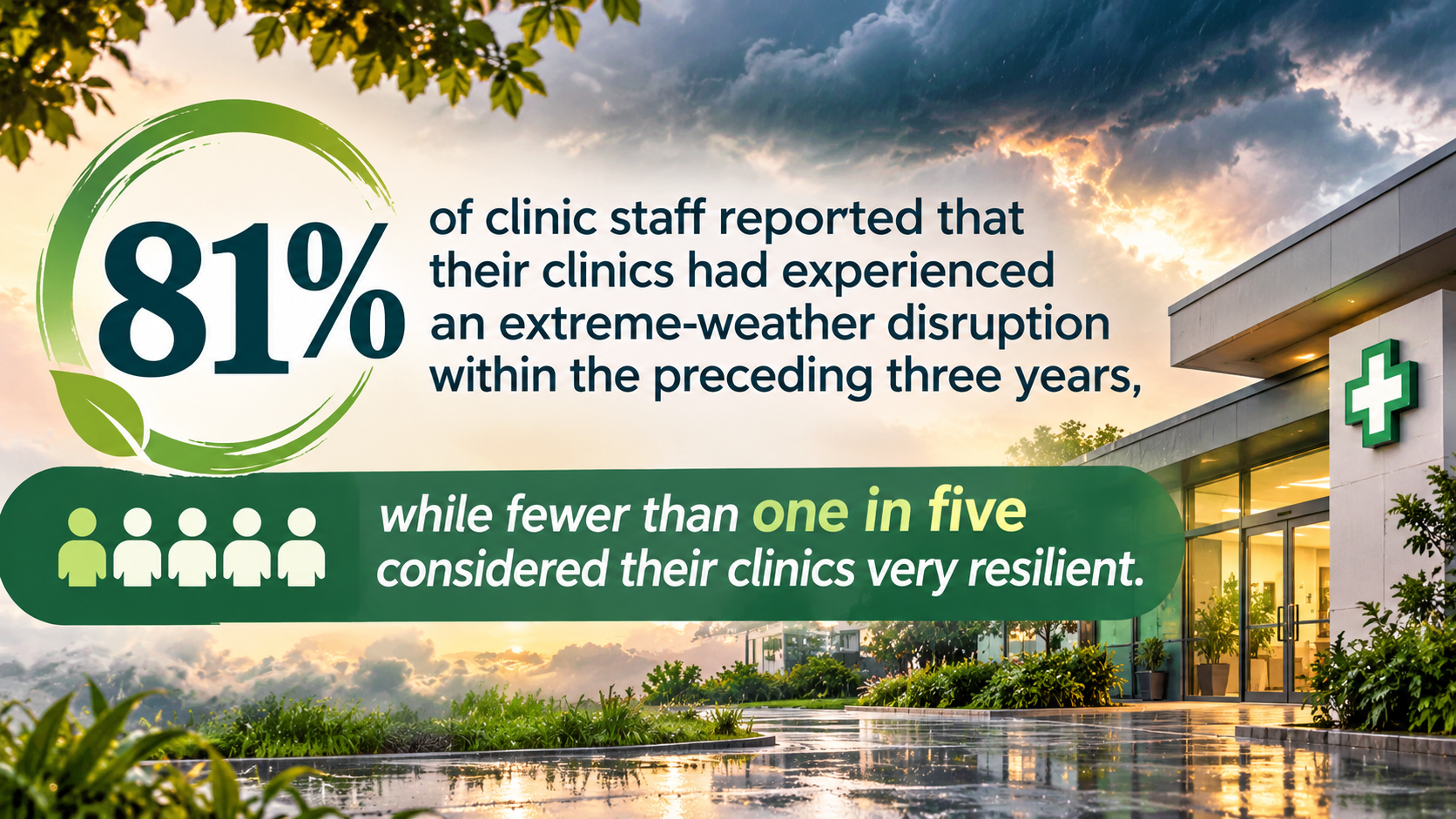
The need is real. In a Harvard survey on climate resilience in healthcare, 81% of surveyed clinic staff reported that their clinics had experienced an extreme-weather disruption within the preceding three years, while fewer than one in five considered their clinics to be very resilient. Fortunately, strengthening resilience does not always require major construction or a large budget. My Green Doctor’s Resilience Planning Workbook offers a practical way for clinics to review vulnerabilities, involve staff, and turn concerns into manageable steps.
First, review energy and essential systems. What will happen during a power failure? Check data backup arrangements, temperature-sensitive supplies, and the ability to maintain access to clinical records. Consider whether energy-efficiency improvements, including perhaps solar panels and batteries to store electricity, could reduce operating costs while strengthening reliability.
Second, assess the facility. Look at roof and drainage maintenance, flood-prone entry points, HVAC performance, and the protection of critical equipment. Local hazards—not a generic national checklist—should guide your priorities.
Third, test your continuity plan. At your next staff meeting, imagine a storm knocking out power and internet access. Who decides whether to close the clinic? How will you contact staff and patients? Choose a backup way to reach people and assign someone to test it.
Fourth, support people. Ask employees where they see risks, review staff training, and evacuation plans. Consider patients who may face transportation, communication, or treatment barriers during a disruption. Clear communication and realistic procedures build confidence before a crisis.
My Green Doctor’s Resilience Planning Workbook can help make these four priorities part of an ongoing improvement process rather than a once-a-year exercise. For additional background on climate-related healthcare risks, the U.S. Department of Health and Human Services provides federal guidance on climate resilience in healthcare. As we celebrate the holidays, My Green Doctor encourages every practice to give itself—and the people it serves—the gift of greater readiness. Here’s to a healthier and more resilient new year.
Book a call with Dr. Todd Sack, Executive Director of My Green Doctor, to help turn your resilience checkup into an action plan for 2027.
https://bit.ly/talk-with-dr-todd-sack
More Resources
- Harvard T.H. Chan School of Public Health — Research on Climate Resilience for Frontline Clinics
https://hsph.harvard.edu/research/climate-health-c-change/outreach/building-climate-resilient-healthcare-clinics/climate-resilience-for-frontline-clinics/ - S. Department of Health and Human Services — Climate Resilience for Health Care Toolkit
https://asprtracie.hhs.gov/technical-resources/resource/12843/climate-resilience-for-health-care-cr4hc-toolkit
El Niño and Winter 2026–27: What Healthcare Clinics Need to Know
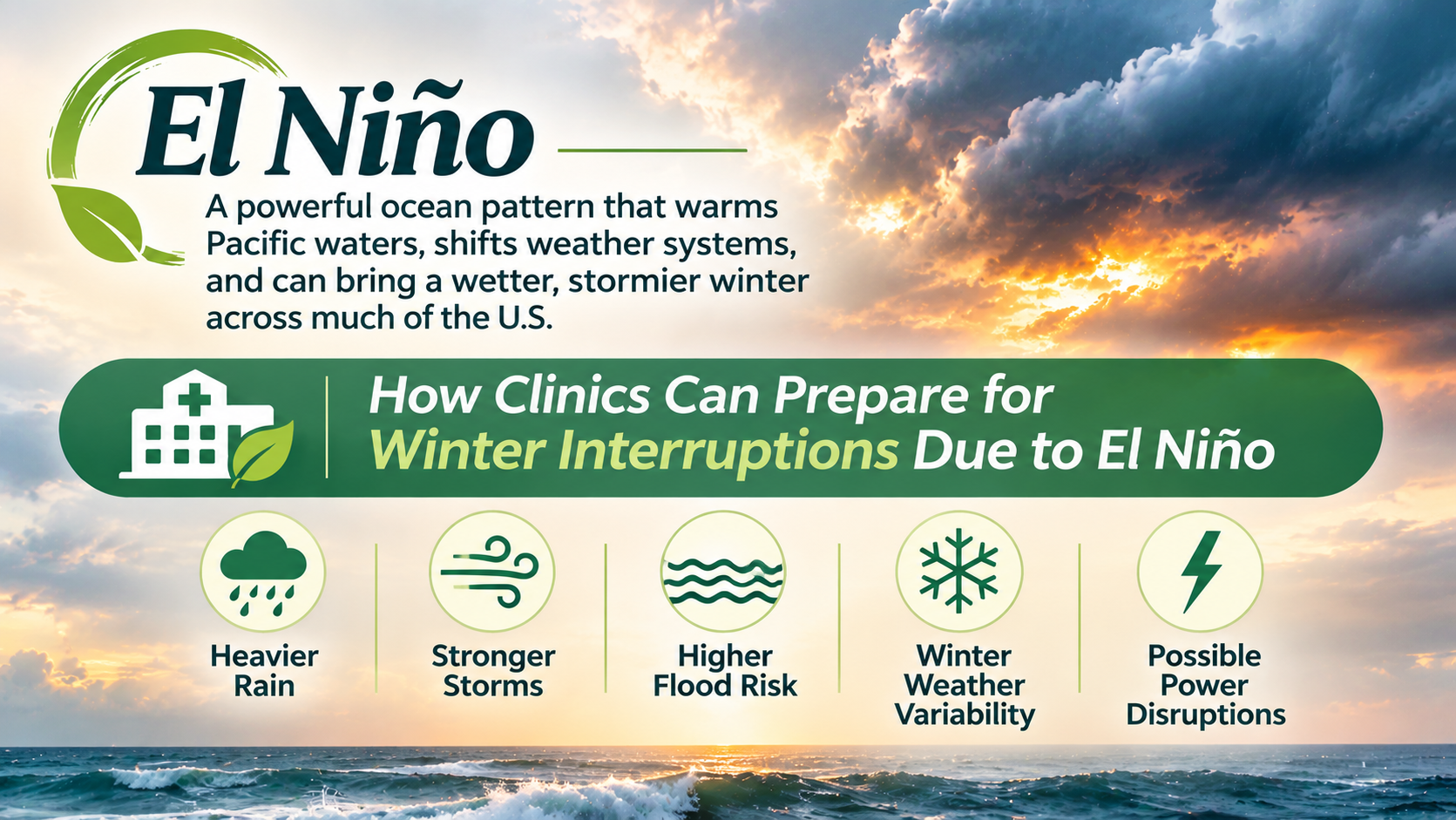
This winter, an ocean-atmosphere pattern thousands of miles away could influence the daily operations of healthcare clinics across the United States. El Niño develops when surface waters in the central and eastern tropical Pacific Ocean become unusually warm, changing atmospheric circulation and shifting the paths of storms. NOAA’s November 19, 2026 outlook report expects a strong El Niño to persist through the winter, with higher odds of wetter-than-average conditions in parts of the southern and eastern United States. The effects will be felt around the world. Columbia University’s November seasonal outlook predicts wetter conditions in southeastern South America and drier conditions in southern Africa.
A seasonal outlook describes probabilities over several months, and local impacts will vary. Nevertheless, wetter conditions in parts of the United States can expose operational vulnerabilities: flooded roads, water intrusion, interrupted electricity, delayed deliveries, staff transportation challenges, and canceled appointments. In other regions, ice, snow, or unusually dry conditions may be the more immediate concern.
For every clinic, the central question is not whether a major weather event will occur, but whether essential services can continue if one does. Start with a site-specific review of roof drainage, entrances, vulnerable equipment, and nearby access routes. Some of the common issues include: confirming who monitors National Weather Service alerts and who has authority to adjust hours or activate emergency procedures; testing backup power arrangements for critical equipment and determining how to protect electronic records, refrigeration, communications, and medication storage during an outage. Are you confident that you can communicate with your staff in an emergency and that each individual will be safe?
Patient communication deserves equal attention. Prepare clear messages for closures, rescheduling, telehealth options where appropriate, and medication or treatment continuity. Identify patients whose care may be especially difficult to interrupt, and make sure staff know how to reach them safely and consistently.
El Niño offers a useful reminder that resilience is not only about surviving an extreme event. It is about reducing avoidable disruption before the first warning arrives. A short preparedness review now can help clinics protect patients, staff, facilities, and trust throughout the winter.
Resilience Planning Workbook can help clinics turn these concerns into a practical preparedness review. By engaging with the MGD Coaching specialists, clinic teams can identify weather-related vulnerabilities, discuss steps to protect essential services, and establish priorities for action. Revisiting the workbook before and during winter can also help keep preparedness responsibilities visible, rather than waiting until severe weather is imminent.
For Further Reading
- NOAA — El Niño Looms Large Over U.S. Winter Outlook
https://www.noaa.gov/news-release/el-nino-looms-large-over-us-winter-outlook - NOAA Climate Prediction Center — Seasonal Outlook Discussion
https://www.cpc.ncep.noaa.gov/products/predictions/90day/fxus05.html - Columbia University — November 2026 Seasonal Forecast.

A $70 Million Investment in Healthcare Resilience: Lessons from Jacksonville
In Jacksonville, Florida, Ascension St. Vincent’s Riverside is making a major investment in the physical resilience of its hospital campus. Nearly $53 million in Federal Emergency Management Agency funding will support an approximately $70 million project designed to reduce vulnerability to hurricane-force winds and flooding. The initiative illustrates an increasingly important principle for healthcare organizations: protecting a building also helps protect continuity of care.
Planned improvements include replacing the main hospital’s roof, exterior windows, and doors to meet current hurricane standards, strengthening older sections of the structure, and addressing potential water intrusion. The project also calls for removable flood barriers and a sump pump system. According to reporting, planning is underway, with work expected to begin around April 2027.
For hospitals located near waterways or in storm-prone regions, these measures can be critical. Water entering a facility, damaged building envelopes, and prolonged power interruptions can disrupt treatment spaces, technology, supplies, and access routes. Infrastructure upgrades are therefore investments in patient safety and service reliability, not merely property protection.
Most outpatient clinics will never undertake a capital project of this size. Yet the lesson scales: identify the greatest hazards, prioritize practical protections, and seek appropriate financing or partnerships before an emergency. Smaller improvements—from securing equipment and protecting records to reviewing drainage and emergency communications—can help clinics reduce downtime and maintain patient access.
Jacksonville’s example demonstrates how proactive resilience planning can support the long-term mission of healthcare: being there when communities need care most.
References
- Florida Times-Union — Jacksonville Hospital Gets $53 Million for Hurricane Damage Prevention
https://www.jacksonville.com/story/news/healthcare/2026/10/12/jacksonville-hospital-gets-53-million-for-hurricane-damage-prevention/92168189007/ - Jacksonville Daily Record — FEMA Grants Nearly $53 Million to Ascension St. Vincent’s Riverside
https://www.jaxdailyrecord.com/news/2026/oct/09/fema-grants-nearly-53-million-to-ascension-st-vincents-riverside/

