Wildfire Preparedness Is Healthcare Preparedness
Wildfires are no longer just a concern for communities near forests or grasslands. Today, wildfire smoke has become a widespread public health issue that can affect patients hundreds or even thousands of miles from an active fire. For primary care practices and for certain specialties such as geriatrics, pulmonary, and cardiology, preparing for wildfire season is no longer optional. It is an important part of being a resilient practice.
Smoke from wildfires contains fine particulate matter (PM2.5) that can penetrate deep into the lungs and enter the bloodstream. Exposure has been linked to worsening asthma, chronic obstructive pulmonary disease (COPD), cardiovascular disease, diabetes, pregnancy complications, and other chronic medical conditions. A recent systematic review also found that wildfire smoke exposure is associated with increased respiratory hospitalizations and higher mortality.
What are the challenges for healthcare?
The challenge for healthcare professionals is that patients often underestimate their risk. Many assume that if they cannot see flames nearby, they are safe. However, research from the record-breaking 2023 Canadian wildfires demonstrated that smoke traveled across North America and even reached Europe, exposing hundreds of millions of people to unhealthy air quality. The health impacts of wildfire smoke are not limited by geography.
How to be prepared and proactive
Fortunately, preparedness does not require expensive new programs. It begins with practical planning and proactive patient education.
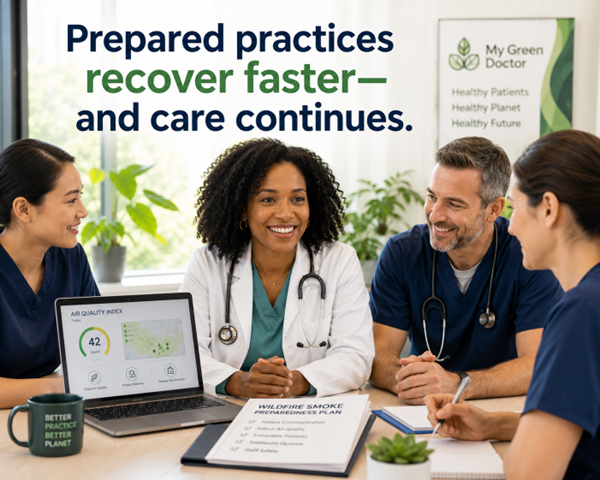
As wildfire season approaches, healthcare teams can use their staff meeting to review asthma and COPD action plans. Part of your plans should be for physicians and nurses to encourage patients to follow every day the local Air Quality Index (AQI) and to provide them the free link: https://www.airnow.gov/aqi/aqi-basics/. Clinics can recommend that patients remain indoors during smoke events, recommend high-quality indoor air filtration in the home, and check that vulnerable patients have adequate supplies of rescue inhalers before poor air quality develops. These conversations are particularly valuable for children, older adults, pregnant women, and patients living with chronic respiratory or cardiovascular disease.
Healthcare organizations should also consider their own operational resilience. Wildfire smoke events can disrupt normal clinic operations, making preparedness essential for maintaining continuity of care. Reviewing HVAC maintenance schedules, evaluating indoor air filtration systems, expanding telehealth capabilities, developing communication plans for high-risk patients, and educating staff about smoke-related health risks can help practices continue serving their communities during prolonged smoke events.
These actions represent more than emergency planning. They are part of building healthcare resilience. A resilient practice anticipates changing conditions, prepares in advance, and continues providing safe, high-quality care even during environmental challenges. As wildfire seasons become longer and more intense, healthcare organizations that prepare today will be better positioned to protect both patients and staff tomorrow.
Free Patient Education Resources
My Green Doctor offers a library of free state-of-the-art waiting room brochures for your patients covering a dozen topics, including our brochure, “Air pollution and Wildfires in a Changing Climate: Protecting Your Family.” These can be read on a computer or smart phone using a URL link or by the QR code that you can give to patients and families. Most are provided in English, Spanish, and Chinese. You are welcome to print these yourself or purchase them economically by emailing My Green Doctor. For Entire Practice Green members, new orders come with a complementary six-brochure display stand for the waiting room. This is about protecting your patients and their families!
Waiting Room Brochures:
https://mygreendoctor.org/resources/waiting-room-brochures/
References
1. Gould CF, Heft-Neal S, Johnson M, et al. Health Effects of Wildfire Smoke Exposure: A Systematic Review and Meta-Analysis. Annual Review of Medicine. https://pmc.ncbi.nlm.nih.gov/articles/PMC12183787/
2. Zhang Q, Wang Y, Xiao Q, et al. Long-range PM2.5 Pollution and Health Impacts from the 2023 Canadian Wildfires. Nature. 2025. https://doi.org/10.1038/s41586-025-09482-1